
Research
Share Knowledge
Brainstorm Ideas
Achieve More
Research
Share Knowledge
Brainstorm Ideas
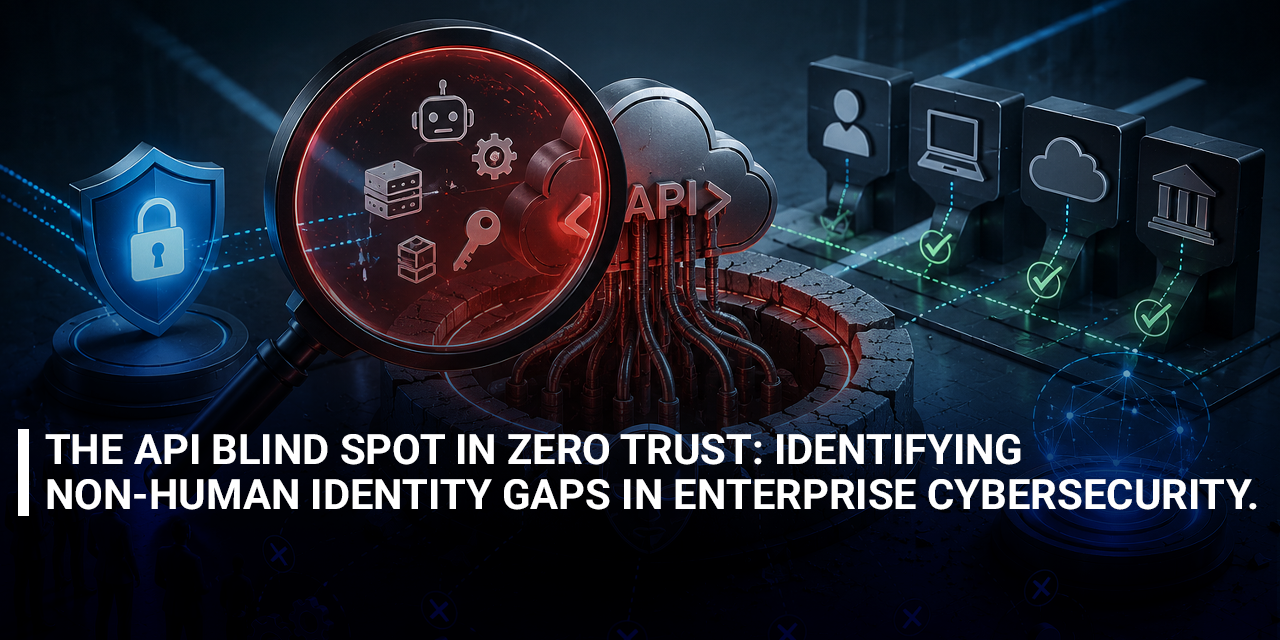
In 2023, a major cloud services provider disclosed that attackers had moved laterally through their environment for months — not by defeating MFA controls or breaching a hardened endpoint, but by compromising a single API key tied to a decommissioned service account that no one had owned for two years. The intrusion bypassed every human-identity control in the organization's Zero Trust architecture because it never touched a human identity.
This is not an edge case. CrowdStrike's 2025 Global Threat Report documents that 79% of attacks now rely on valid credentials and living-off-the-land techniques rather than malware — exploiting exactly the unmonitored machine identities that conventional Zero Trust frameworks leave unaddressed. IBM's Cost of a Data Breach Report 2024 puts the average cost of a credentials-based breach at $4.88 million globally, with regulated industries incurring substantially higher costs.
The strategic imperative is clear: Zero Trust cannot stop at the human perimeter. API-layer identity — every service account, token, microservice credential, and automated agent — must be governed with the same rigor as applied to human logins.
Zero Trust adoption has reached critical mass. Most large enterprises have either implemented or are actively building toward a Zero Trust model, and boards rightly credit that investment for measurably reducing breach exposure to the human perimeter — phishing-resistant MFA, hardened endpoints, network micro-segmentation.
These controls work. However, they do not address the surface where most attacks now begin. That surface is machine identity.
Non-human identities — API keys, service accounts, OAuth tokens, automation credentials, and AI agent identities — now vastly outnumber human users in most enterprise environments, in some organizations by factors exceeding 50-to-one (Gartner, Identity and Access Management Report, 2024). Unlike human identities, they are rarely subject to lifecycle management, access reviews, or disciplined deprovisioning. Credentials persist beyond their intended use. Service accounts accumulate privileges over time. API keys are embedded in code repositories and forgotten across ownership transitions.
For leadership, this reframes the essential question. It is no longer a question of whether your organization has a Zero Trust strategy. It is whether that strategy extends to the non-human workforce that executes most of your digital transactions.
Zero Trust's foundational principle — never trust, always verify — was designed for an era when the authenticated user was the primary threat vector. Today, for every employee who logs in, dozens of automated processes, microservices, and API integrations exchange data, execute transactions, and access sensitive systems. Most operate invisibly, under identities provisioned without the governance controls applied to human accounts.
The consequence is a structural blind spot. An enterprise can deploy best-in-class authentication, endpoint detection, and network segmentation, and remain fundamentally exposed if its API layer operates on long-lived static credentials, overprivileged service accounts, and ungoverned token issuance. Adversaries do not need to defeat a hardened perimeter if they can move freely through a utility corridor that was never included in the architecture diagram.
Closing this gap requires a paradigm shift. Every API call, every microservice request, and every automated workflow must be treated as a principal — subject to verified identity, least-privilege authorization, and continuous behavioral monitoring.
Salt Security's State of API Security Report 2024 found that 95% of organizations experienced an API security incident in the prior twelve months. The threat is not a hypothetical future exposure. It is where breaches are occurring today, in production environments that passed their last security audit with high marks.
The question is no longer "trust the network because the user passed MFA." It is: "verify the machine, the token, and the specific action — every time, with no standing exceptions."
Across industries, a consistent pattern is emerging. The following archetypes reflect the most common deployment scenarios and the structural vulnerabilities they expose.
Payment orchestration and transaction processing environments contain some of the highest concentrations of orphaned service accounts and forgotten keys in any industry — precisely the credentials adversaries target for fraud and lateral movement.
Financial institutions that have implemented short-lived token architectures and runtime authorization controls in these environments consistently report material reductions in unauthorized transaction attempts and dramatically shorter fraud investigation cycles. The pattern reinforces a broader principle: the highest-value targets require the most granular machine identity controls.
Health systems integrating telehealth platforms, EHR connectors, and claims processing pipelines with third-party APIs face persistent HIPAA exposure when access relies on hard-coded credentials that persist through vendor contract changes, system upgrades, and staff turnover.
Organizations that have brought third-party API integrations under machine identity governance — enforcing just-in-time access and automated deprovisioning — have eliminated an entire class of audit findings and significantly reduced the manual overhead associated with vendor access reviews.
In microservices architectures, overprivileged service accounts and misconfigured API keys represent simultaneous security and financial risk. Unauthorized resource provisioning through compromised machine identities drives both data exposure and unbudgeted cloud consumption.
Least-privilege API identity controls address both vectors, reducing misconfiguration incidents while eliminating the compute overhead associated with unauthorized workloads.
The most strategically significant pattern concerns autonomous AI agents. Enterprises deploying agents that call APIs across internal and partner systems are introducing a new generation of non-human identities with elevated capabilities and, in most current deployments, minimal governance. An AI agent operating under an ungoverned machine identity can exfiltrate data, trigger transactions, or propagate through connected systems — not maliciously, but because no authorization boundary was defined.
Requiring every AI agent to operate under a cryptographically verifiable, least-privilege identity is not the best practice aspiration — it is a prerequisite for responsible enterprise AI deployment.
Organizations typically traverse three recognizable stages when extending identity governance to the API layer. Understanding which stage your enterprise currently occupies is the precondition for planning the right next investment.
| Stage | Characteristics |
|---|---|
| Stage 1 Reactive Visibility |
The organization lacks a comprehensive inventory of APIs, service accounts, and tokens. Discovery is incident-driven; credentials are long-lived and rotated reactively when problems surface. Risk is largely undisclosed: the organization cannot quantify what it does not know exists. This is where most enterprises currently sit. |
| Stage 2 Managed Governance |
A formal inventory is established and maintained. Machine identity follows a defined lifecycle — provisioned with least-privilege scopes, reviewed periodically, and deprovisioned automatically at end-of-life. Short-lived tokens replace static credentials for high-privilege integrations. Security teams can answer: "What has access to this system, and does it still need to?" |
| Stage 3 Continuous Authorization |
Every API call is evaluated in real time against a dynamic policy that considers identity, behavioral baseline, and data sensitivity. Anomalous patterns — an agent accessing an endpoint outside its normal scope — are detected and interrupted automatically. This is Zero Trust fully realized across both human and non-human principals. |
IBM data suggests organizations with mature Zero Trust architectures containing API-layer controls detect and contain breaches significantly faster than those without, translating directly into lower incident response costs, reduced regulatory exposure, and measurable improvements in cyber-insurance positioning. The maturity progression is also cumulative: each stage produces an independent security value while enabling the next.
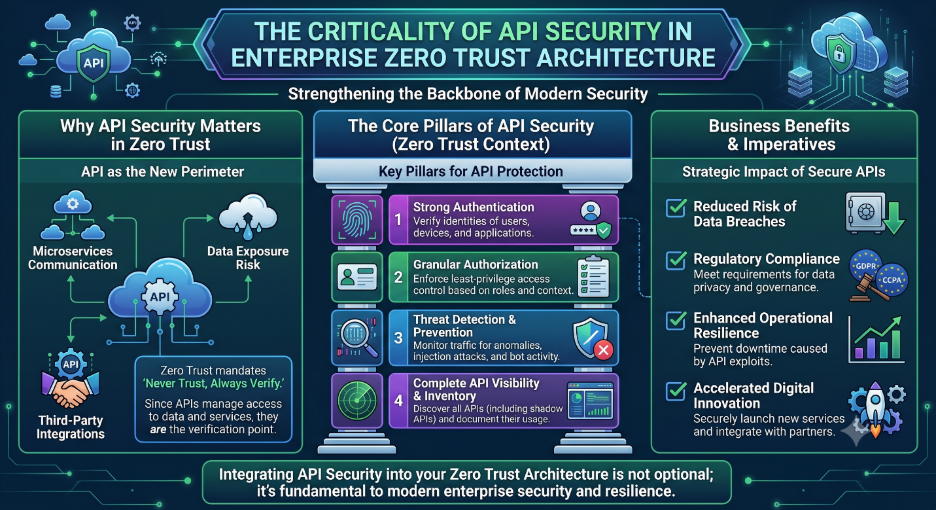
The business case for API identity governance spans the full C-suite. Each executive function carries a distinct stake in the outcome.
The calculus combines breach cost avoidance — IBM's 2024 global average of $4.88 million per incident, substantially higher in regulated industries — with the operational savings of automating credential lifecycle management. Manual rotation of API keys and service account audits at the scale of modern enterprises is both costly and error prone. Automation eliminates that overhead while materially improving outcomes.
API identity governance closes the identity loop that boards and regulators are scrutinizing with increasing specificity. It produces the audit trail — which principal called what endpoint, when, from where, under what authorization — that regulatory frameworks require and that incident response teams depend on when breaches occur. It also provides a defensible answer to the question boards are beginning to ask directly: "Do we know who has access to our systems?"
The exposure is reputational and competitive. API breaches involving customer data carry consequences that extend far beyond technical remediation: regulatory investigation, mandatory notification obligations, and the erosion of the digital trust that underpins partner ecosystems and customer retention. The governance posture that protects against these consequences is increasingly a competitive differentiator — particularly in industries where digital trust is a procurement criterion.
Three enablers determine whether API identity governance succeeds in practice. The sequencing matters.
Organizations cannot govern what they cannot see. Salt Security's 2024 research found that a significant majority of enterprises cannot fully account for all active APIs and service credentials in their environment. A comprehensive discovery and inventory exercise — spanning production, staging, and legacy systems — is the precondition for every subsequent control.
Machine identities must be brought into the same governance frameworks applied to human identities: provisioning standards, access scoping, periodic review, and deprovisioning triggers. This is as much a people and process challenge as a technology one. Development teams accustomed to long-lived embedded credentials need secure-by-design pipelines — vault integrations, secrets management platforms, automated rotation — that reduce friction rather than add bureaucracy.
Governance at the scale of modern non-human identity populations cannot be sustained manually. The implementation risk is real but manageable: a phased approach beginning with crown-jewel APIs and high-privilege service accounts limits disruption while demonstrating measurable value before broader rollout. Runtime behavioral monitoring, applied alongside policy controls, validates that legitimate automation continues to function while anomalous patterns are surfaced.
Regulators and auditors are narrowing the gap between expectation and enforcement.
NIST SP 800-207, the foundational Zero Trust architecture standard, explicitly requires continuous verification for all principals — human and machine — without carve-outs for automated processes.
GDPR Article 32 and ISO/IEC 27001:2022 both require that access controls be applied comprehensively.
The SEC's cybersecurity disclosure rules, effective since 2023, create explicit board-level accountability for material cybersecurity risks, including those arising from identity governance gaps that were previously treated as operational details.
Responsible AI governance adds a distinct regulatory dimension. Autonomous agents operating under ungoverned machine identities contradict the transparency, accountability, and human oversight principles embedded in the EU AI Act and emerging AI governance frameworks globally. Organizations deploying AI at scale without corresponding machine identity controls are accumulating regulatory exposure in two domains simultaneously.
For boards and risk committees, the argument is unambiguous: API identity governance is simultaneously a security control, a demonstrable compliance investment, and a defensible expression of fiduciary duty. The cost of establishing these controls is predictable and bounded — the cost of the incidents they prevent is not.
Zero Trust was never designed to stop at the human perimeter. Its architects understood that in a distributed, cloud-native, API-connected enterprise, the relevant question is not who is accessing a system — it is what is accessing it, why, with what authorization, and whether that authorization remains appropriate in this moment.
As digital business becomes API-driven and AI-augmented, the identity boundary must expand to encompass every service account, token, and autonomous agent in the enterprise. The technical capability to close this gap exists today, across a mature ecosystem of secrets management platforms, API security solutions, and identity governance tools. The strategic will to prioritize it over the next 18 months is the variable that will determine which organizations lead and which ones explain.
The organizations that extend their Zero Trust architecture to the machine identity layer will reduce breach exposure, accelerate compliance, and build the governance infrastructure required for the next decade of AI-augmented operations. Those that delay are compounding undisclosed risk with every new integration, every new AI deployment, and every forgotten credential that survives another rotation cycle.
Organizations that act will define the security standard. The rest will be case studies.
Connect with top-tier cybersecurity professionals and GRC specialists with ITPN talent procurement & consultancy services. Our solutions delivery platform, MyGenie, connects organizations with vetted talent, industry-standard operational & strategic frameworks, solution accelerators, best practices, and more.