
Research
Share Knowledge
Brainstorm Ideas
Achieve More
Research
Share Knowledge
Brainstorm Ideas
The paradox of modern enterprise technology lies within its legacy core. While digital transformation and advanced analytics command boardroom focus, legacy systems anchor enterprises to trillions in technical debt. For CEOs, CIOs, and CFOs, the fundamental challenge is no longer deciding whether to modernize but executing it without inducing drastic operational downtime or undermining fiscal predictability.
The paradox of modern enterprise technology lies within its legacy core. While digital transformation and advanced analytics command boardroom focus, legacy systems anchor enterprises to trillions in technical debt. For CEOs, CIOs, and CFOs, the fundamental challenge is no longer deciding whether to modernize but executing it without inducing drastic operational downtime or undermining fiscal predictability. This article outlines an evolutionary, risk-mitigated modernization framework tailored for executive leadership.
The systems that built the modern enterprise are increasingly becoming the primary impediments to its future growth. Monolithic core applications—often operational for two to three decades— frequently represent millions of lines of sparsely documented code with deeply embedded and brittle dependencies. Yet, these architectures run the core transactional systems, supply chains, and financial systems that sustain global enterprise operations.
According to research by McKinsey, CIOs estimate enterprise technical debt at 20 - 40% of their total technology asset value before depreciation, acting as a massive tax on innovation and agility. Gartner projects that organizations may soon direct approximately 40% of their IT budgets towards technical debt servicing rather than innovation.
For a billion-dollar enterprise, this represents an annual loss of tens of millions of dollars redirected to maintenance rather than market differentiation. Concurrently, the scarcity of technical talent proficient in legacy code bases introduces a systemic key-person vulnerability that deepens each quarter.
When confronted with the legacy dilemma, a common executive response is to authorize a comprehensive, full-scale replacement—often termed the 'Big Bang' migration. This rip-and-replace strategy replaces the old system entirely on a single deployment date. Statistically and operationally, this approach introduces unacceptably high enterprise risk profiles.
No wonder research consistently shows around 70 - 80% of large-scale digital transformations failing to meet their stated objectives or suffering massive cost overruns. McKinsey notes 70% falling short and Gartner projects 80% of scaling efforts falling through in 2025 – 26.
A complete migration forces a business to pause its innovation roadmaps to build an exact parity system on modern infrastructure. During this multi-year freeze, competitors operating on agile, cloud-native frameworks capture market share. More dangerously, the operational shock of cutting over vast, tightly coupled architectures simultaneously can lead to catastrophic business interruptions, revenue leakage, and immediate regulatory penalties.
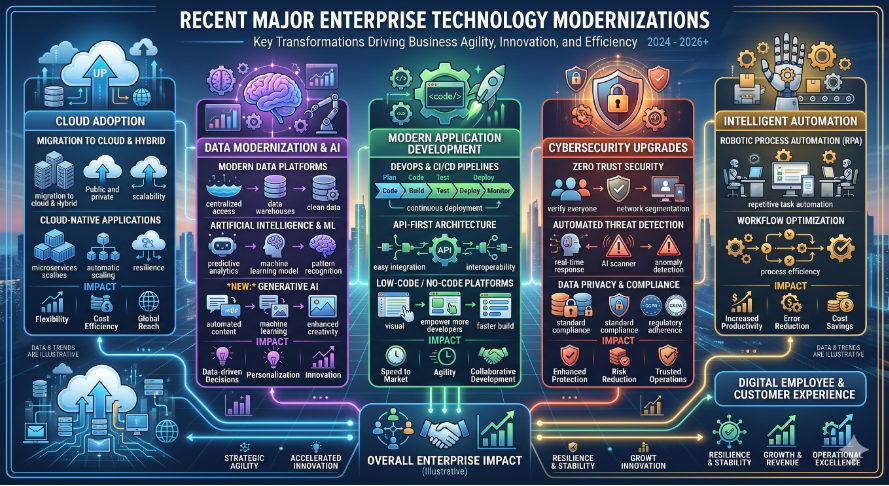
The alternative to high-risk deployment is continuous, evolutionary modernization. Rather than viewing modernization as a singular, capital-intensive IT project, successful C-level executives reframe it as a continuous operational capability. By systematically decoupling the core monolith into modular, cloud-native microservices, the enterprise ensures business-as-usual continuity while progressively updating its technology capabilities.
| Strategic Dimension | The Big Bang Paradigm (High Risk) | The Evolutionary Paradigm (De-risked) |
|---|---|---|
| Risk Management | Concentrated on a single deployment window; high operational shock potential. | Distributed incrementally; minimal, isolated blast radii. |
| Capital Allocation | Massive, upfront CapEx with delayed ROI realization. | Phased OpEx/CapEx tied directly to realized business value. |
| Market Agility | System freeze for months or years to achieve feature parity. | Continuous delivery of new digital features during migration. |
The primary mechanism that makes evolutionary modernization operational — not just theoretical — is the Strangler Fig Pattern.
Developed by Martin Fowler, chief scientist at ThoughtWorks, and named after the strangler fig tree that gradually envelops and replaces an existing tree, the Strangler Fig Pattern involves placing an API façade around an enterprise's legacy core. Business capabilities are built as external modern services, while existing capabilities are systematically intercepted and migrated one domain at a time.
To the end-user and internal business operations, the system functions seamlessly. Behind the scenes, traffic is rerouted from legacy subsystems to modern microservices based on specific rules. This strategy shrinks the blast radius of any migration event to a single, easily testable business domain.
A primary concern for the CFO and CISO during a modernization initiative is data integrity and compliance. To maintain continuity, legacy databases and new cloud databases must run in parallel without data degradation. This requires modern integration patterns such as Change Data Capture (CDC) and, where needed, dual-write patterns, with CDC being the preferred approach because it avoids the consistency risks of dual-write.
When an operational change occurs, CDC mechanisms carry out near-real-time data synchronization across both modern and legacy repositories. This dual-run phase ensures that if a newly deployed service experiences anomalous behavior, traffic can be instantly rolled back to the legacy system without data loss, latency, or financial reconciliation issues.
A zero-disruption strategy requires tight alignment across the executive leadership team, with each member owning a distinct vector of the transformation:
The CEO Perspective: Modernization is a strategic defensive and offensive tool. It safeguards brand equity from operational failure while providing the technical foundation to leverage machine learning, predictive analytics, and real-time market responses.
The CFO Perspective: Shifting from massive, unpredictable capital allocations toward a predictable, phased operational model aligns technology investments with quarterly cash flows and actual business consumption.
The CIO & CTO Perspective: Transforming legacy codebases into modular, decoupled architectures simplifies talent acquisition, slashes deployment lead time, and accelerates engineering velocity.
The CISO Perspective: Legacy software is inherently harder to secure due to irregular or unsupported patching cycles and a lack of visibility. Incremental modernizations allow for the seamless embedding of Zero Trust architectures —which require verification for every access request, regardless of network location —directly into the software supply chain and CI/CD pipelines.
Modernizing legacy systems without operational disruption requires a shift from a technology-first perspective to a business-capability-centric approach. To execute this transition successfully, the executive team must commit to three immediate architectural actions:
• Execute a Domain-Driven Value Audit: Inventory the legacy monolith not by code lines, but by business value. Prioritize modernization for domains where agility drives competitive edge (e.g., customer acquisition channels) and leave stable, back-office domains for later phases.
• Mandate API-First Interoperability: Enforce a strict architectural rule that no new system may directly query the legacy database. All interactions must proceed through managed API layers to ensure system isolation.
• Establish Modernization Metrics Tied to KPIs: Evaluate engineering teams not on abstract migration timelines, but on tangible metrics: technical debt reduction, system uptime, and feature delivery cycle time.
Not every legacy system requires decomposition into microservices — some domains are better candidates for rehosting or retention. The value of evolutionary architecture lies precisely in its ability to make those decisions domain by domain, rather than forcing a single answer across the entire infrastructure.
By treating legacy modernization as a disciplined, continuous business evolution, corporate leaders protect operational baselines, optimize capital efficiency, and build a resilient technology foundation capable of sustaining enterprise growth for decades to come.
ITPN helps enterprises modernize and transform their legacy infrastructure into agile, secure, and future-ready digital ecosystems that accelerate innovation, reduce operational risk, and unlock measurable business value.
Connect with our vetted network of solution architects, cloud architects, automation engineers, AI/ML specialists, and cybersecurity engineers to build a highly proficient team that shows ownership and delivers exceptional success consistently.
Get in touch to access industry-standard knowledge assets such as solution accelerators, implementation frameworks, best practices, and more, completely for free.